
The problem
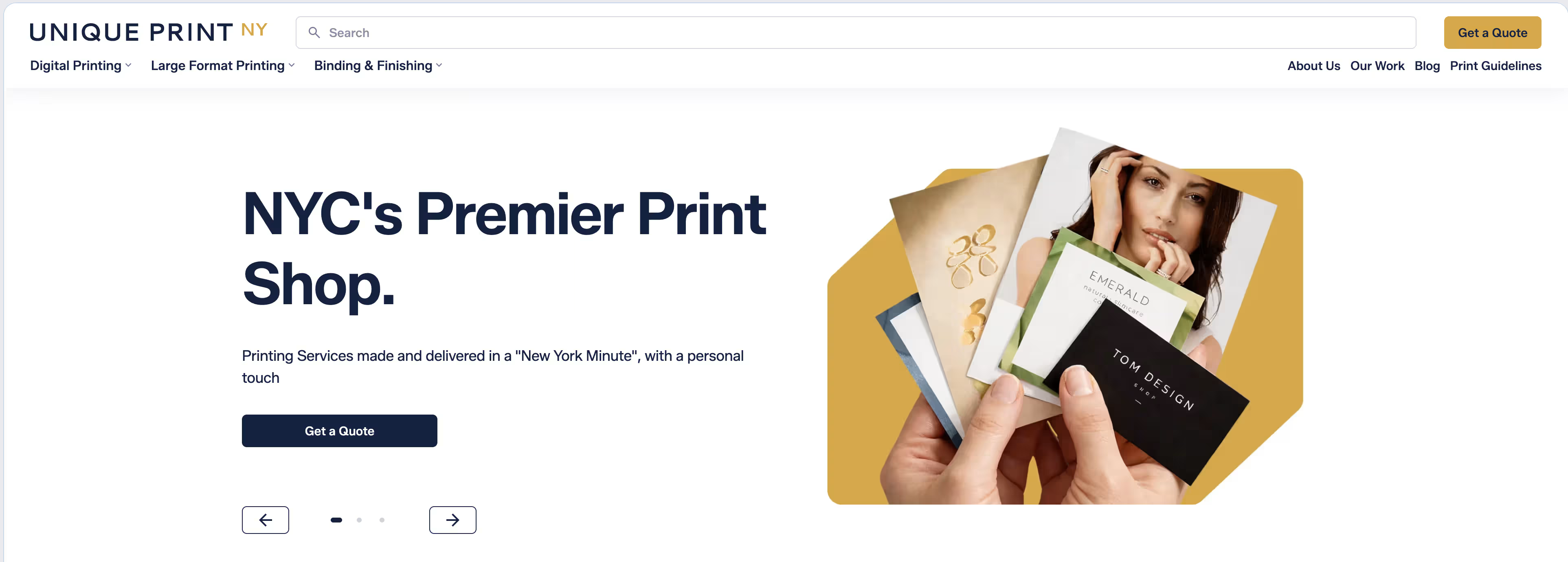
Unique Print NY needed a website that made it easier for customers to see what the shop could produce and request a quote. Photography was central to the redesign. A finished window installation or a close-up of a printed piece could explain the work better than a list of services alone.
The business owner wanted a clearer path from browsing to requesting a quote. The SEO partner needed to preserve the search visibility the old site had already earned and reviewed performance monthly. Behind the scenes, the team was still building rich layouts by pasting hand-written HTML into the WordPress Classic Editor. Meanwhile, third-party scripts loaded through Google Tag Manager were already affecting performance scores during development.
I was responsible for the WordPress implementation.
What I built
A block editor for new and existing content
I turned recurring layouts from Figma into reusable Gutenberg blocks so the team could create and update posts visually. The existing posts needed to work in the new editor too, so I wrote a migration plugin that converted their hand-written HTML into the new block structure. That let us move the existing content without asking the team to rebuild each post by hand.
A lighter frontend for a photography-heavy site
I added Vite to the custom Bedrock-based theme so I could work with TypeScript and Tailwind CSS using a workflow I already knew from Vue and Nuxt. I loaded critical CSS separately and used data attributes to identify which interactive components were on each page. The theme could then load the JavaScript those components needed on demand.
For a site where photography does much of the selling, image delivery mattered as much as the JavaScript. I optimized images in AVIF and WebP and built a WordPress plugin that generated responsive `srcset` attributes, allowing browsers to pick an appropriate image size for the visitor’s screen.
For a site where photography does much of the selling, image delivery mattered as much as the JavaScript. I optimized images in AVIF and WebP and built a WordPress plugin that generated responsive `srcset` attributes, allowing browsers to pick an appropriate image size for the visitor’s screen.
A quote form built around print jobs
I rebuilt the quote form around the information the print shop needed to review a request. I defined the validation rules with Zod and added a multi-file uploader so customers could attach several files in one submission. The form previews supported images and shows a file icon for other attachments, so customers can check what they’ve selected before sending.
I integrated the form with SendGrid so the shop could receive the request and the customer could keep a copy of what they submitted.
I integrated the form with SendGrid so the shop could receive the request and the customer could keep a copy of what they submitted.
After launch
I used the Redirection plugin to map old URLs to their new destinations with permanent redirects that preserved query parameters. I also continued optimizing images across older posts as the SEO partner reviewed the site each month.
The result
The client was happy with the rebuild. Customers could browse examples of the shop’s work, submit a quote with multiple attachments, and receive a copy of their request. The team could update legacy posts and create new ones through the same block editor.
Quote requests continued to come in during the period I followed after launch. I didn’t have access to conversion-rate data, so I can speak to how the new flow worked and the fact that customers continued using it.
Quote requests continued to come in during the period I followed after launch. I didn’t have access to conversion-rate data, so I can speak to how the new flow worked and the fact that customers continued using it.
What I’d improve next
I’d revisit the site’s third-party scripts with the SEO partner. I tested Partytown as a way to move compatible scripts off the main thread. The production setup kept the existing approach, and my next step would be to review which tags need to run early, which can wait for consent or interaction, and which can move off the main thread without disrupting measurement.
I’d also add a section that tells the stories behind selected print jobs. A service page can tell me that a shop prints on glass. A project story can show me what a client needed, what made the installation tricky, and how the shop pulled it off. For a business that’s been around since 1977, I’d start by asking the team which jobs they still talk about. As a Friends fan, I’d be especially curious to hear the story behind the shop’s appearance on the show.
I’d also add a section that tells the stories behind selected print jobs. A service page can tell me that a shop prints on glass. A project story can show me what a client needed, what made the installation tricky, and how the shop pulled it off. For a business that’s been around since 1977, I’d start by asking the team which jobs they still talk about. As a Friends fan, I’d be especially curious to hear the story behind the shop’s appearance on the show.



